
Navigating the journey of pregnancy brings a multitude of changes to your body, and staying active can sometimes feel like a complex puzzle – especially when it comes to engaging your core. As a dedicated Prenatal Exercise Specialist and Certified Personal Trainer, my mission is to empower you with the knowledge and confidence to embrace exercising safely during pregnancy, ensuring both your well-being and that of your growing baby.
You’ve likely heard the advice: traditional abdominal exercises like crunches and intense sit-ups are generally not recommended during pregnancy. This isn’t just a guideline; it’s a crucial consideration because these movements can place excessive, unhealthy pressure on your abdominal wall. Instead, the focus shifts to gentle, functional, and pregnancy-safe core exercises that effectively support your burgeoning belly, bolster your pelvic floor, and promote optimal posture without unnecessary strain or risk.
Your core muscles play an indispensable role not just throughout your pregnancy, but also during the demanding process of labor and the vital period of postpartum recovery. By consciously choosing gentle, functional movements, you actively work to protect your abdominal wall from excessive stretching and separation, thereby significantly reducing the risk of developing diastasis recti (abdominal separation). Furthermore, these targeted exercises lay a strong foundation for a smoother, more efficient recovery after your baby arrives, helping your body regain its strength and stability. These foundational movements are also key in fostering overall stability and strength, making everyday tasks, the physical demands of motherhood, and even preparing for birth itself, feel more manageable and less taxing.
Below, I’m delighted to share 5 highly effective and pregnancy-safe core exercises that I personally endorse and incorporate into my clients’ routines. Each of these movements is carefully selected for its simplicity, effectiveness, and the convenience of being performed comfortably at home with minimal to no equipment. If you’re seeking a more comprehensive and structured approach to your prenatal fitness, my acclaimed GOOD // SWEAT Pregnancy Guide offers a meticulously designed program featuring 26 weeks of workouts specifically tailored for the second and third trimesters, providing trimester-specific guidance and modifications to support you every step of the way.
1. Cat Cow
The Cat Cow exercise is a wonderfully gentle yet incredibly effective movement for promoting spinal mobility and relieving tension in the back, which is often a common complaint during pregnancy. To begin, assume a comfortable position on all fours, ensuring your hands are aligned directly under your shoulders and your knees are pelvis-width apart under your hips. Distribute your weight evenly through your hands and knees.
As you inhale slowly and deeply, allow your belly to gently drop towards the floor, arching your back to enter the “Cow” position. Lift your gaze slightly forward, opening your chest, but avoid overextending your neck. Feel the gentle stretch along your spine. Then, as you exhale, gently round your spine towards the ceiling, tucking your chin towards your chest and engaging your core muscles subtly, moving into the “Cat” position. Imagine pulling your naval up towards your spine. Hold this arched position for 1-2 seconds, feeling the release in your back.
This rhythmic movement not only enhances flexibility in your spine but also encourages mindful breathing, which is invaluable for both pregnancy and labor. It helps to alleviate lower back pain and can improve overall posture as your body adapts to the growing weight of your baby. Focus on the gentle connection between your breath and movement.
Modification: Always keep your movements slow and deliberate, especially during pregnancy, to avoid any sudden jarring or strain on your joints and ligaments, which are naturally looser due to hormonal changes. Perform 8-12 repetitions, focusing on fluidity and breath.
2. Bird Dog
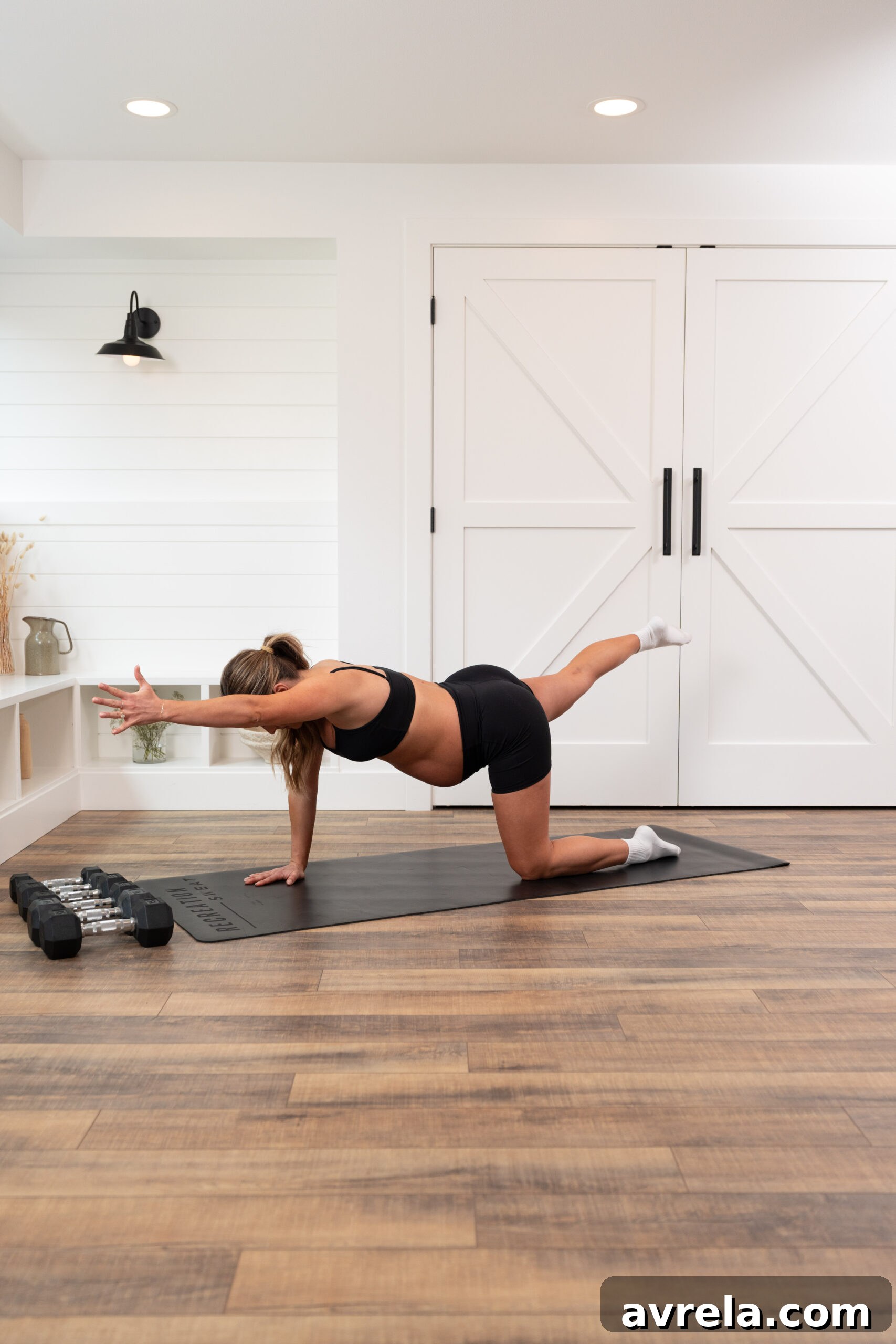
The Bird Dog is an exceptional exercise for developing core stability, balance, and coordination without placing any direct pressure on the abdominal wall, making it perfectly safe for all trimesters of pregnancy. It strengthens the deep core muscles, including the transversus abdominis, which is essential for supporting your spine and pelvis during pregnancy and beyond.
Begin on all fours, similar to the Cat Cow, with your hands directly under your shoulders and knees under your hips, spaced pelvis-width apart. Establish a neutral spine—imagine a straight line from the crown of your head to your tailbone. Inhale to prepare, gently engaging your core. As you exhale, slowly and with control, extend your right arm forward, keeping it parallel to the floor, while simultaneously straightening and lifting your left leg backward, also parallel to the floor. The goal is to keep your hips level and your core stable, resisting any urge to rock or twist your torso.
Hold this extended position for a few seconds, focusing on maintaining a neutral neck, spine, and pelvis—no tipping side to side, tucking your tailbone, or overarching your back. Your core should be actively engaged to prevent any movement in your torso. Inhale as you smoothly lower your arm and leg back to the starting position. Take a moment to reset, then repeat the movement on the opposite side, extending your left arm and right leg. Aim for slow, controlled movements, prioritizing form over speed.
This exercise is incredibly beneficial for strengthening the posterior chain (back and glutes) and improving balance, which can become more challenging as your center of gravity shifts during pregnancy. It directly supports posture and can help alleviate back discomfort. Perform 8-10 repetitions on each side, completing 2-3 sets.
Modification: If maintaining balance is difficult, or if you feel any strain, you can modify by lifting just an arm or just a leg at a time, rather than simultaneously. Slowing down the movement even further will also help you gain more control and stability. Ensure your breath is continuous and deep throughout the exercise.
3. Pelvic Clock
The Pelvic Clock is a fantastic exercise for promoting pelvic mobility, which is exceptionally important during pregnancy for comfort, maintaining proper posture, and preparing the body for labor. It helps to release tension in the lower back and hips, areas that often bear increased strain as pregnancy progresses.
To perform this exercise, sit comfortably on a stability ball (or a sturdy chair if a ball isn’t available) with your feet planted wide and firmly on the floor. Ensure your spine is tall, your chest is lifted, and your shoulders are relaxed. Place your hands gently on your hips or belly, or one hand on your belly and the other over your heart, to enhance your mind-body connection. Take a moment to focus on deep, abdominal breathing, feeling your belly expand with each inhale and gently contract with each exhale, extending into the sides and back of your torso.
Now, imagine a clock face on the seat beneath you. Gently tilt your hips forward towards “12 o’clock” (anterior tilt) and then backward towards “6 o’clock” (posterior tilt). This movement should be subtle and controlled, initiating from your pelvis, not your entire torso. Next, gently lift one hip slightly, moving towards “3 o’clock,” and then shift to lift the other hip towards “9 o’clock.” These lateral shifts enhance hip mobility. Finally, combine these movements to perform full, gentle circles with your pelvis, moving clockwise and then counter-clockwise. Keep the movements small, fluid, and controlled throughout. This is not about large, dramatic movements, but rather subtle articulations.
The Pelvic Clock helps to loosen up the sacrum and lumbar spine, promoting flexibility in an area that can become stiff and painful. It also increases awareness of your pelvic floor and core muscles, which is vital for preparing for childbirth and supporting your body postpartum. Practice for 1-2 minutes in each direction, or for 10-15 tilts in each plane.
Modification: If you find yourself overextending or experiencing discomfort, consciously perform smaller, even more controlled movements. The goal is gentle mobility and awareness, not a deep stretch. If a stability ball is too unstable, a firm chair can be used, although the range of motion might be slightly reduced.
4. Modified Side Plank Reach Through
The Modified Side Plank Reach Through is an excellent exercise for strengthening the obliques and lateral core muscles, which are crucial for stability and supporting the increasing weight of your pregnant belly. Unlike traditional planks, this modified version minimizes pressure on the abdominal wall while still effectively engaging the core.
Start in a modified side plank position: lie on your side, propped up on your forearm. Ensure your elbow is directly under your shoulder. Bend your inner knee (the one closer to the floor) to create a stable base, keeping it stacked directly under your hip. Extend your outer leg straight, placing your outer foot either in front of or behind your inner knee, whatever feels most stable. Lift your hips off the floor, forming a straight line from your head to your bent knee, engaging your core and glutes. Avoid sagging your hips.
From this stable side plank position, reach your outer arm straight up towards the ceiling, creating a long line of energy. This is your starting point. As you exhale, slowly and with control, twist your torso and “reach through” the space between your supporting arm and your body, bringing your raised hand towards your hip or lower back. Feel the engagement in your obliques as you rotate. Inhale as you smoothly return your arm to the overhead position, opening your chest. Perform 8-12 repetitions on one side before carefully switching to the other side.
This exercise not only targets the side abdominal muscles but also improves rotational stability and shoulder strength. It’s particularly beneficial for preventing back pain by creating a strong, supportive girdle around your torso. Remember to keep your movements fluid and avoid holding your breath.
Modification: For increased support and stability, you can keep both knees bent on the floor, stacking them, while still lifting your hips to create a diagonal line. Focus on controlled rotation and engagement of your side core muscles rather than speed. If you feel any strain in your shoulder, reduce the range of the reach-through or simply hold the modified side plank position.
5. DB (Dumbbell) Drive the Car
The “DB Drive the Car” exercise is a fantastic way to engage your rotational core muscles and improve dynamic stability, all while being completely safe for pregnancy. It uses a very light weight to provide resistance, helping to strengthen the core without any direct pressure on the linea alba or risking abdominal separation. This movement mimics functional tasks, preparing your body for the twists and turns of daily life with a baby.
To set up, stand with your feet hip-width apart, ensuring they are firmly planted, and maintain a slight bend in your knees to protect your joints and provide a stable base. Hold one very light dumbbell (or even a small water bottle or resistance band) with both hands, extending it straight out in front of you at chest height. Keep your shoulders relaxed and your core gently engaged, with a tall posture.
From this starting position, slowly and with control, alternate rotating the weight approximately 45 degrees to the left and then 45 degrees to the right. Imagine you are gently steering a car. The movement should primarily originate from your core and torso, with your hips remaining relatively stable and facing forward. Avoid twisting your entire body aggressively; the rotation should be controlled and focused on your mid-section. Ensure your arms remain mostly straight, pivoting from your shoulders and engaging your abdominal muscles as you rotate.
This exercise enhances oblique strength and rotational power, which are vital for daily activities like reaching for items, lifting, and carrying. It also helps to maintain flexibility in the spine and torso. Perform for 30-60 seconds, or for 10-15 rotations in each direction, completing 2-3 sets. Focus on smooth, deliberate movements rather than fast, jerky ones.
Modification: Always opt for lighter weights during pregnancy, or even no weight at all, focusing solely on the core engagement and controlled movement. If you feel any discomfort or strain, slow down the movement even further. The key is to feel your core engaging to control the rotation, rather than relying on momentum or excessive force.
Why Safe Core Exercises Matter During Pregnancy
The profound physiological transformations that occur during pregnancy, particularly the expansion of your belly, fundamentally alter your body mechanics and center of gravity. This makes it not just important, but absolutely essential to be acutely mindful of how you approach core training. Engaging in safe core exercises during pregnancy, such as the five foundational movements detailed above, offers a wealth of benefits far beyond mere fitness. You’re not merely working out; you’re proactively safeguarding your body and preparing it for the incredible journey ahead.
By consistently incorporating these gentle yet effective exercises, you will significantly protect your abdominal wall from excessive strain and potential separation, notably reducing the risk of diastasis recti. Simultaneously, you’re bolstering the strength and resilience of your pelvic floor, which is critical for supporting the growing weight of your uterus and baby, preventing incontinence, and aiding in a smoother labor and delivery. A strong, functional core also acts as a natural corset, providing crucial support for your spine, alleviating common pregnancy-related back pain, and promoting better posture as your body adapts to its new shape.
Furthermore, these exercises lay a vital foundation for efficient labor and a quicker, more comfortable postpartum recovery. A well-conditioned core provides the stability needed for various labor positions and supports effective pushing. Post-delivery, these muscles will be better equipped to recover and regain their strength, aiding in the healing process and helping you navigate the physical demands of new motherhood with greater ease and reduced discomfort. Remember, consistency and mindful execution are key; even small, intentional movements contribute significantly to preserving core strength and overall stability throughout your entire pregnancy.
Always listen attentively to your body’s signals. Avoid any movements that induce discomfort, pain, or the appearance of “coning” or “doming” along your midline – a tell-tale sign of excessive intra-abdominal pressure. Do not hesitate to make modifications as needed; every pregnancy is unique, and what feels good one day might need adjustment the next. Prioritizing safety and comfort ensures a beneficial and empowering exercise experience.
For those seeking comprehensive, expert-guided support throughout this special time, including trimester-specific workouts, safe modifications, and a holistic approach to prenatal fitness, my GOOD // SWEAT Pregnancy Guide is meticulously designed to support you every single step of the way, fostering strength, confidence, and well-being for you and your baby.
More Pregnancy-Safe Fitness Resources:
- When to Modify Workouts During Pregnancy
- The 5 Stretches You Should Do Daily For Pregnancy
- Benefits of Exercise During Pregnancy: Why It’s So Important
- Building Your Pregnancy Support Squad: 5 Helpful Experts to Consider on Your Journey
- Yoga Ball Exercises for Pelvic Floor During Pregnancy: 7 Moves for Strength & Flexibility