
Are you ready to invigorate your fitness routine and discover new levels of strength and coordination? While the fundamentals of exercise are crucial, and we believe in keeping workouts effective without unnecessary complexity, there comes a time when adding a fresh twist can significantly enhance your progress. Introducing variations to classic movements not only prevents plateaus but also challenges your brain, refines your balance, sharpens your agility, and keeps your muscles perpetually engaged and adapting.
The lunge is a cornerstone exercise in any comprehensive strength training regimen, celebrated for its effectiveness in building lower body strength and improving unilateral stability. But what happens when you elevate this foundational movement? Prepare to ‘spice up’ your leg day with three dynamic lunge variations that promise to challenge your entire body, ignite new muscle groups, and inject excitement back into your training. These aren’t just minor tweaks; they’re transformative exercises designed to enhance your athletic prowess and overall fitness.
The Power of Lunges: A Foundation for Functional Fitness
Before diving into the exciting variations, let’s briefly revisit why lunges are indispensable. Lunges are a unilateral exercise, meaning they work one side of your body at a time. This is critical for identifying and correcting muscular imbalances, improving stability, and mimicking real-life movements like walking, running, and climbing stairs. They primarily target the quadriceps, hamstrings, and glutes, while also heavily engaging the core for stabilization. By incorporating lunge variations, you don’t just work these muscles harder; you work them smarter, introducing new planes of motion, resistance profiles, and dynamic challenges that lead to superior results.
Diversifying your lunge repertoire offers a multitude of benefits:
- Enhanced Muscle Activation: Different variations target muscle fibers in unique ways, promoting more comprehensive development.
- Improved Balance and Stability: Unilateral movements are natural balance trainers, and dynamic variations amplify this effect.
- Increased Agility and Coordination: Movements that involve quick changes in direction or dynamic kicks improve your body’s ability to react.
- Prevention of Plateaus: Constantly introducing new stimuli keeps your muscles from adapting too comfortably, ensuring continuous progress.
- Boosted Core Strength: Many lunge variations demand intense core engagement to maintain posture and control throughout the movement.
- Functional Strength: Training movements that mimic daily activities makes you stronger and more resilient in everyday life.
Reverse Lunge To High Kick: Dynamic Power and Core Control
This explosive variation takes the traditional reverse lunge and elevates it into a full-body dynamic movement that will significantly challenge your balance, power, and core strength. It’s an excellent way to not only build strong glutes and quads but also to enhance cardiovascular endurance and coordination. The Reverse Lunge to High Kick is a testament to how small additions can create a profound impact on an exercise.
How to Perform: Begin by standing tall with your feet hip-width apart. Step back with your right foot into a deep reverse lunge, ensuring your front knee is directly over your ankle and your back knee hovers just above the ground. As you push off the mat quickly with your right foot, drive your knee forward and upward into a powerful high kick. Extend your leg fully, aiming to kick as high as comfortably possible. Simultaneously, reach across your body with your left hand towards your kicked right foot (or as close as you can get), adding a rotational core challenge. Control the descent back to the starting position, either by stepping back into another lunge or returning your foot to the ground. Complete all reps on one side before switching.
Key Benefits: This movement profoundly challenges your standing leg’s stability and strength, increasing its time under tension. The dynamic kick engages your hip flexors and deep core muscles, while the opposite hand reach adds a crucial rotational component, fortifying your obliques. Expect a significant increase in heart rate, making this a fantastic option for metabolic conditioning. It also develops explosive power in your lower body, crucial for athletes and everyday functional movements alike. Your glutes, quadriceps, hamstrings, and entire core musculature will be engaged and firing throughout this triple-threat exercise.
Tips for Optimal Form: Maintain a strong, engaged core throughout the entire movement to stabilize your torso. Focus on a controlled descent into the lunge and an explosive, yet controlled, kick. Keep your chest lifted and shoulders back. If reaching your foot is too challenging, aim to reach towards your shin or knee. For added difficulty, increase the speed of the kick while maintaining control.
Cable Lateral Lunges: Unlocking Lateral Strength and Mobility
While most exercises focus on forward and backward movements, the lateral lunge introduces a critical plane of motion often neglected: the frontal plane. Adding the consistent resistance of a cable machine to this movement transforms it into a powerful exercise for building strength, improving hip mobility, and sculpt
ing the inner and outer thighs. The cable machine provides tension through both the concentric (muscle shortening) and eccentric (muscle lengthening) phases of the exercise, meaning your muscles are under constant work, leading to superior muscle growth and control.
How to Perform: Set up a cable machine with a single-grip handle at a low pulley position. Stand facing perpendicular to the machine, holding the handle with the hand farthest from the machine (e.g., if the cable is to your right, hold it with your left hand). Step out to the side with your leg closest to the machine, keeping your other leg straight. Lower your hips back and down, as if sitting into a chair, ensuring your lunging knee tracks over your toes. Keep your chest up and your back straight. The cable will pull you towards the machine, requiring significant core and inner thigh engagement to resist. Push off your lunging foot to return to the starting position, contracting your glutes and inner thighs. Complete all reps on one side before switching.
Key Benefits: Cable Lateral Lunges are exceptional for targeting the often-underdeveloped adductor (inner thigh) and abductor (outer thigh) muscles, as well as the glutes, quadriceps, and hamstrings. The constant tension from the cable machine ensures deep muscle engagement throughout the entire range of motion, promoting both strength and hypertrophy. This exercise also significantly improves hip mobility and stability, which are vital for athletic performance and preventing injuries in daily life. The unilateral nature, combined with the lateral pull, also intensifies core activation, particularly the obliques, as you resist the rotational force.
Tips for Optimal Form: Ensure your lunging knee tracks in line with your toes and does not collapse inward. Keep your stationary leg straight but not locked. Focus on driving through the heel of your lunging foot as you return to the start. Adjust the cable weight to ensure you can perform the movement with control and proper form, rather than letting the weight dictate your movement. Maintain a neutral spine and engage your core to prevent unwanted twisting.
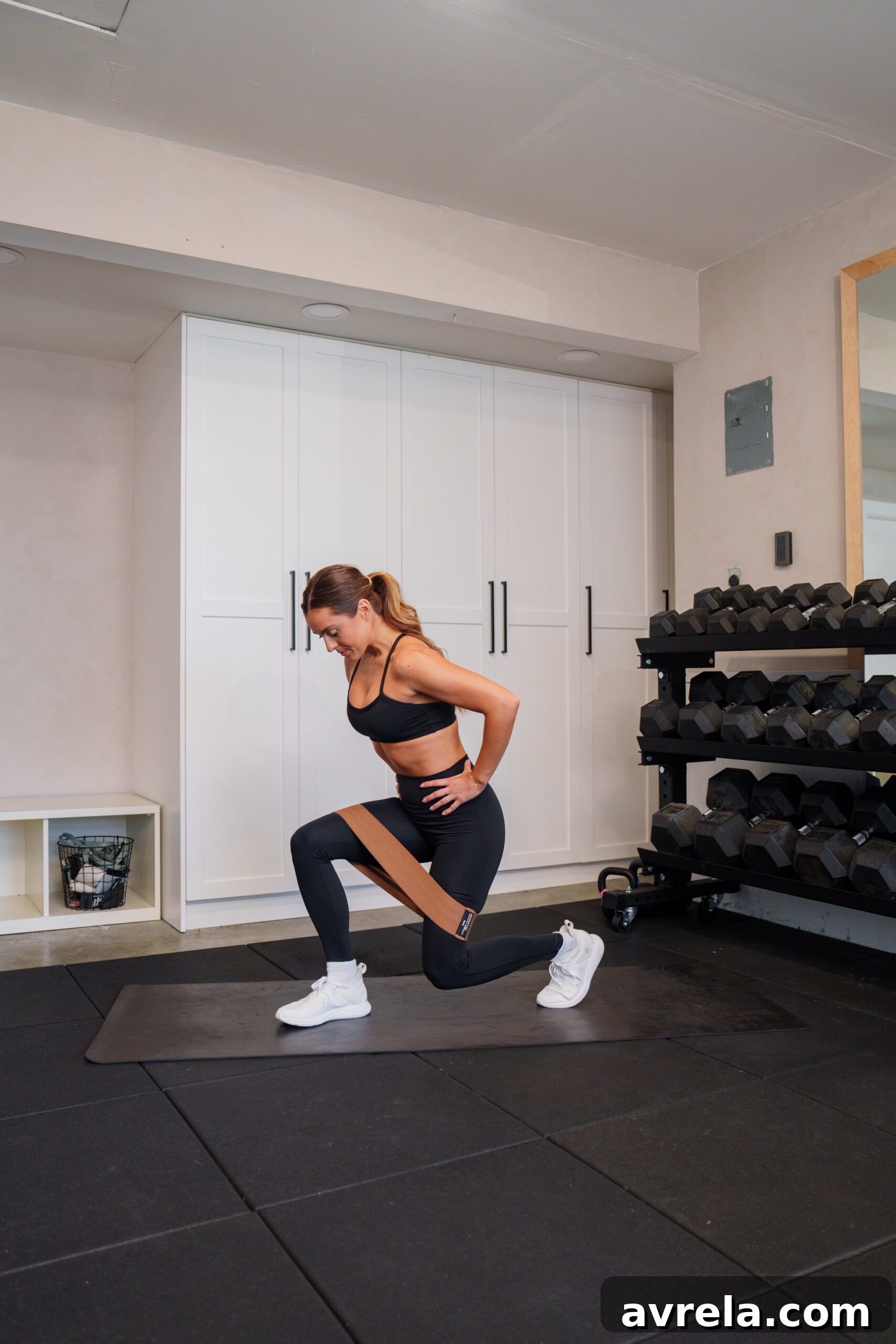
Banded Walking Lunges: Amplify Glute Activation and Endurance
Sometimes, the simplest additions can create the most challenging and effective workouts. Banded Walking Lunges are a perfect example. By merely adding a resistance band, you transform a standard walking lunge into a formidable glute-sculpting and endurance-building exercise. Don’t let their deceptive simplicity fool you; these will undoubtedly leave your muscles guessing and your glutes sore in the best possible way!
How to Perform: Place a resistance band (a loop band is ideal for this) just above your knees. Stand with your feet hip-width apart, ensuring the band has slight tension. Step forward with your right foot into a lunge, lowering your hips until both knees are bent at approximately a 90-degree angle. Your front knee should be aligned over your ankle, and your back knee should hover just above the ground. As you lunge, actively press your knees outwards against the resistance of the band to engage your glute medius. Push off your back foot and bring it forward to meet your front foot, then immediately step forward with your left foot into the next lunge. Continue alternating legs, moving forward across the floor.
Key Benefits: The primary advantage of adding a resistance band to walking lunges is the constant tension and increased activation of your glute muscles, particularly the glute medius and minimus. These muscles are crucial for hip stability, knee tracking, and preventing injuries. The band forces you to actively engage these muscles to prevent your knees from caving inward, leading to more effective glute development and improved lower body mechanics. This variation also significantly boosts muscular endurance and strength in your quadriceps and hamstrings, all while challenging your balance and coordination as you move forward. It’s a highly functional exercise that translates well to everyday activities and sports.
Tips for Optimal Form: Choose a band resistance that allows you to maintain good form throughout the set. Focus on keeping tension on the band by pushing your knees slightly outwards with each step. Maintain an upright posture, keeping your core tight and chest lifted. Take controlled steps, ensuring proper knee alignment over your toes. Avoid letting the band pull your knees inward, as this diminishes the glute activation and can put stress on your knees. Consistency in form is key to maximizing the benefits and preventing injury.
I use Recreation Sweat for my resistance bands. You can use code Rachael15 for 15% off!
Integrating These Variations into Your Workout Routine
To reap the full benefits of these dynamic lunge variations, consider how to best incorporate them into your existing fitness regimen. You might choose one variation to focus on each leg day, or rotate through all three over the course of your training week. Aim for 3-4 sets of 8-12 repetitions per leg for each exercise. Remember to always prioritize proper form over heavy weight or high reps. Start with lighter resistance or no resistance until you’ve mastered the movement pattern. These variations can serve as excellent primary exercises for your lower body day, or as challenging finishers to truly fatigue your muscles.
Beyond the physical benefits, introducing these new movements keeps your workouts mentally stimulating and prevents boredom. The brain is just as important a muscle to train as your glutes, and mastering new movement patterns enhances neuromuscular coordination, making you a more efficient and capable mover both inside and outside the gym.
Beyond the Lunge: The Importance of a Well-Rounded Fitness Program
While these lunge variations offer incredible benefits for lower body strength, balance, and agility, remember that they are just one piece of the larger fitness puzzle. A truly effective and sustainable fitness program incorporates a balance of strength training, cardiovascular exercise, flexibility work, and adequate recovery. Continuously challenging your body with varied exercises, proper nutrition, and sufficient rest is the recipe for long-term health and athletic success. Use these lunge variations as a springboard to explore new ways to challenge your body and keep your fitness journey exciting and progressive.
Embrace the challenge, feel the burn, and enjoy the journey of becoming a stronger, more balanced, and agile version of yourself!
Looking for more fitness content?
Try my 8-Week Strength Training Program, GOOD // SWEAT Strength
5 Ways To Build Muscle Mass in 2025
10 Benefits Of Strength Training
My Go-To Lower Body Workout